Why 2026 is the Year to Replace Your SaaS Tools with AI Agents
Discover why 2026 is the year to replace SaaS tools with AI agents and how businesses can gain a competitive edge with AI-driven solutions.

In 2026, the landscape of business technology is undergoing a seismic shift. A staggering 50% of the SaaS tools currently in use are predicted to be replaced by AI agents by the end of the year. This transition is more than just a trend; it represents a fundamental rethinking of how businesses operate, deliver services, and interact with customers. Traditional SaaS models, while effective for many years, are being overshadowed by the capabilities of AI agents that promise to streamline operations, enhance decision-making, and deliver personalized experiences. As businesses scramble to keep pace with this evolution, the question arises: how can you effectively replace your SaaS tools with AI agents and leverage this shift for competitive advantage?
The problem is clear: relying solely on existing SaaS solutions may hinder your organization’s ability to innovate and adapt. As AI agents become increasingly sophisticated, they will not only take on routine tasks but also provide insights and automations that traditional software cannot. This guide will explore the transition from traditional SaaS to AI-driven solutions, highlighting the benefits of AI agents over traditional SaaS tools and offering actionable steps to make the switch. By the end of this guide, you’ll understand how to replace your SaaS tools with AI agents, the efficiency gains associated with these tools, and how to position your business as a leader in this new landscape.
By 2026, Gartner predicts that 40% of enterprise applications will feature task-specific AI agents, a significant increase from less than 5% in 2025. This shift is not just a prediction; it’s a reality that organizations must prepare for now. You will learn how to identify which tools to replace, how to assess AI SaaS solutions, and the key strategies for integrating AI agents into your existing workflows. Let’s explore why 2026 is the year to replace SaaS tools and how you can capitalize on this pivotal moment in technology.
Why AI Agents Matter in 2026
The rise of AI agents is redefining the capabilities of business software. Unlike traditional SaaS tools that require user inputs and manual interactions, AI agents function autonomously to optimize workflows and enhance productivity. For instance, according to a recent report from Deloitte, AI agents are expected to create efficiencies that can reduce operational costs by up to 30% by automating repetitive tasks.
Understanding AI Agents
AI agents are software programs that use artificial intelligence to perform tasks, make decisions, and automate processes without direct human intervention. This contrasts sharply with SaaS tools, which often require users to navigate complex interfaces and perform tasks manually. AI agents can learn from data, adapt to user preferences, and execute tasks more efficiently than traditional software.
The Competitive Edge
In 2026, businesses that integrate AI agents into their operations will have a distinct competitive advantage. AI adoption has skyrocketed, with a recent Salesforce study reporting a 282% increase in AI usage among CIOs. By leveraging AI agents, organizations can enhance customer experiences, streamline internal processes, and generate insights that drive innovation.
The biggest change is visual. We no longer need a UI for every tool. An Agentic Interface acts as an orchestration layer.
The Transition from SaaS to AI
Transitioning from traditional SaaS tools to AI-driven solutions requires careful planning and execution. Companies must evaluate their current SaaS stack, identify which tools are ripe for replacement, and understand the capabilities of available AI agents. By 2026, it's expected that at least 50% of the functions provided by traditional SaaS tools will be taken over by AI agents.
Identifying Tools for Replacement
Start by auditing your existing SaaS tools. Look for applications that are primarily transactional or routine in nature, as these are often the best candidates for replacement with AI agents. For example, customer support tools like Zendesk can be enhanced with AI chatbots that resolve common inquiries without human intervention.
Evaluating AI Solutions
When considering AI SaaS solutions, look for platforms that offer integration capabilities with your existing infrastructure. Tools like Microsoft Azure AI or Google Cloud AI provide robust frameworks for deploying AI agents that can seamlessly replace traditional tools.
By December 2026, AI agents will replace at least 50% of the SaaS tools you use today.
Benefits of AI Agents Over SaaS
The benefits of adopting AI agents over traditional SaaS tools are multifaceted. Efficiency gains with AI tools can dramatically improve workflows, allowing teams to focus on higher-value tasks.
Reduced Operational Costs
AI agents can automate repetitive tasks, resulting in significant cost savings. For instance, AI-driven CRM systems can manage customer interactions without requiring a dedicated sales team, reducing labor costs and increasing efficiency.
Enhanced Decision-Making
AI agents process vast amounts of data to deliver actionable insights. Companies leveraging AI are expected to make more informed decisions, leading to improved business outcomes. A report from Gartner indicates that organizations utilizing AI for decision-making are 40% more likely to outperform their competitors.
AI agents promise to streamline operations, enhance decision-making, and deliver personalized experiences.
Custom Software vs. SaaS: The New Paradigm
As businesses weigh the pros and cons of existing SaaS tools versus AI agents, the debate between custom software and SaaS also surfaces. While SaaS tools offer off-the-shelf solutions, custom software can be tailored to specific business needs.
Flexibility and Scalability
Custom software solutions can provide the flexibility that many organizations need as they scale. With AI agents, businesses can develop tailored solutions that integrate with existing systems, allowing for greater agility in responding to market changes.
Long-Term Cost Considerations
While SaaS tools typically have lower upfront costs, custom software may offer better long-term ROI. According to a 2026 analysis, organizations that invest in custom AI solutions can see up to 50% higher returns compared to those relying solely on SaaS.
By 2026, we will likely see a lot of experimentation, a general augmentation of capabilities, and a slow restructuring of the SaaS market.
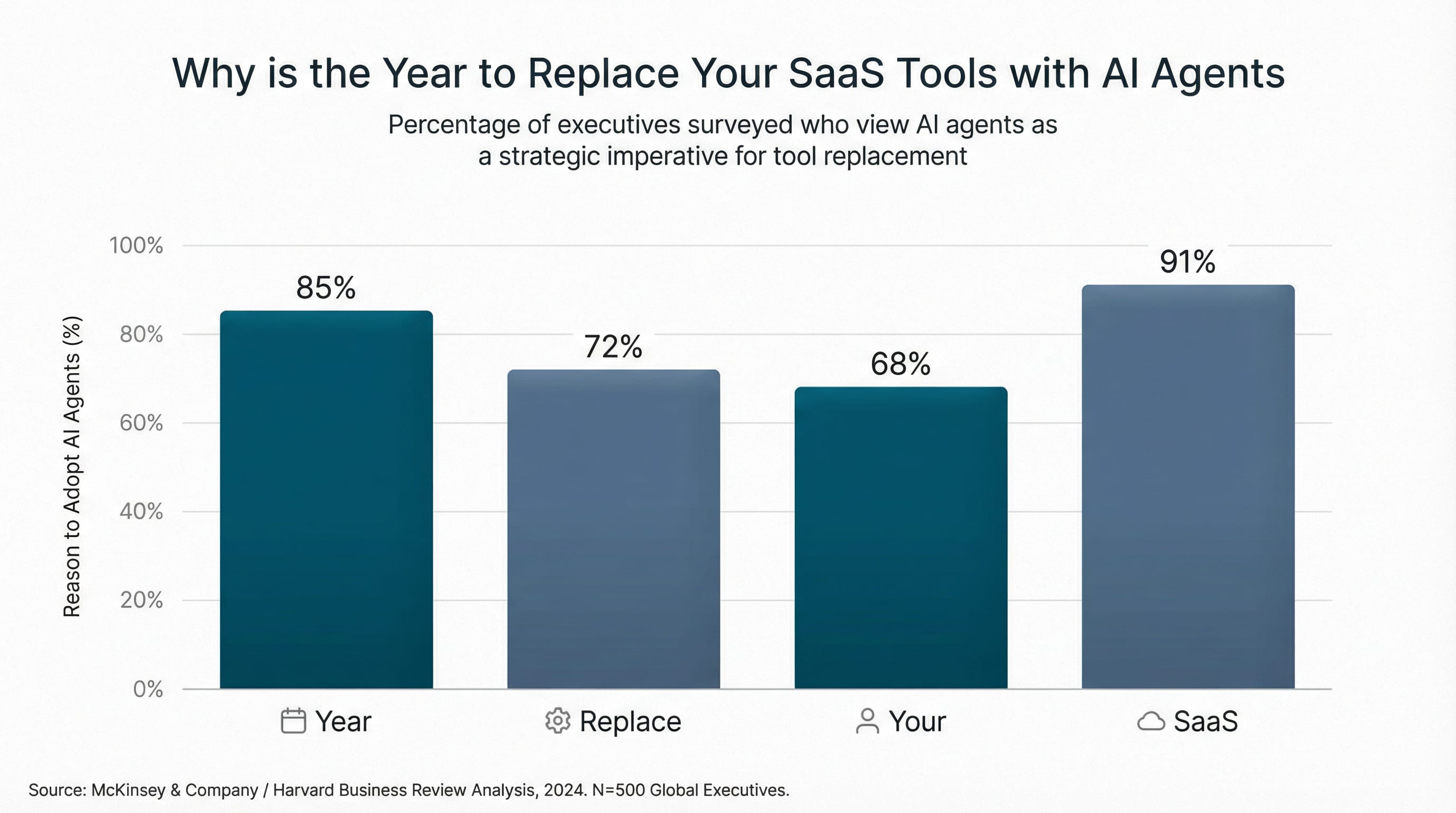
Case Studies: AI Adoption in Action
Real-world examples of companies successfully transitioning from SaaS to AI agents can provide valuable insights into the process. Consider the case of a mid-sized e-commerce company that replaced its legacy customer support system with an AI agent.
Streamlined Customer Support
By implementing an AI-driven chatbot solution from Intercom, the company achieved a 70% reduction in customer support response times. This not only improved customer satisfaction but also freed up human agents to handle more complex queries.
Boosted Sales with Predictive Analytics
Another example is a retail organization that adopted AI for inventory management. By using predictive analytics powered by AI, the company reduced excess stock by 30% and increased sales by 15%, demonstrating the tangible benefits of AI integration.
AI agents can learn from data, adapt to user preferences, and execute tasks more efficiently than traditional software.
Checklist for Transitioning to AI Agents
Transitioning from traditional SaaS tools to AI agents requires a structured approach. Here’s a checklist to guide you through the process:
- Conduct an audit of your existing SaaS tools.
- Identify tools that are primarily transactional or routine.
- Research AI solutions that align with your business goals.
- Evaluate integration capabilities of potential AI agents.
- Develop a roadmap for implementation, including timelines and milestones.
- Train your team on the new AI tools and processes.
- Monitor performance and make adjustments as necessary.
Myths About AI Agents in Business
As the conversation around AI agents grows, several myths continue to circulate that can hinder organizations from embracing this technology. It’s essential to debunk these misconceptions to pave the way for successful adoption.
AI Will Replace Human Workers
Many fear that AI agents will replace human jobs. However, the reality is that AI is designed to augment human capabilities, not replace them. A report from PwC indicates that 73% of jobs will see some form of AI integration, enhancing productivity rather than eliminating roles.
AI Tools Are Too Complex to Implement
Another common myth is that AI tools are complicated and require extensive technical expertise. In reality, many AI solutions, such as those offered by Salesforce and HubSpot, are designed with user-friendliness in mind, enabling businesses to adopt them with relative ease.
The smartest SaaS companies aren't resisting a repurpose but rather embracing the change by integrating AI agents into their platforms.
Actionable Steps for 2026
As you prepare to replace your SaaS tools with AI agents, consider the following actionable steps to ensure a smooth transition:
- Start with a pilot program to test AI agents on a small scale.
- Gather feedback from users to refine the integration process.
- Invest in training and resources to support your team during the transition.
- Continuously monitor the performance of AI agents and adapt as necessary.
- Stay informed about emerging AI trends and technologies that can benefit your organization.
Conclusion
The future of business technology lies in the hands of AI agents. By 2026, the shift from traditional SaaS tools to AI-driven solutions will be more than just a trend; it will define competitive advantage in the marketplace. Organizations must act now to replace their SaaS tools with AI agents, leveraging the benefits of efficiency gains, enhanced decision-making, and improved customer experiences. Embrace this change, and position your business at the forefront of innovation in this new era.
Maya Chen
Maya Chen is a Staff Writer at SaasAudited with a keen focus on SaaS product analysis and technology trends. With a background in software development and data analytics, she brings a unique perspective to her reviews, drawing on her experience as a former tech consultant and analyst.